How will my wool look as a coat or a suit before I sample it?
Its face, its pattern and the way it folds: one photo of your wool becomes six garments in that cloth, from a clean worsted to a brushed flannel. What it will not show is the tailoring inside, the canvas and the pressing that make a wool jacket sit right. Two free renders, shared across all our tools. No account.
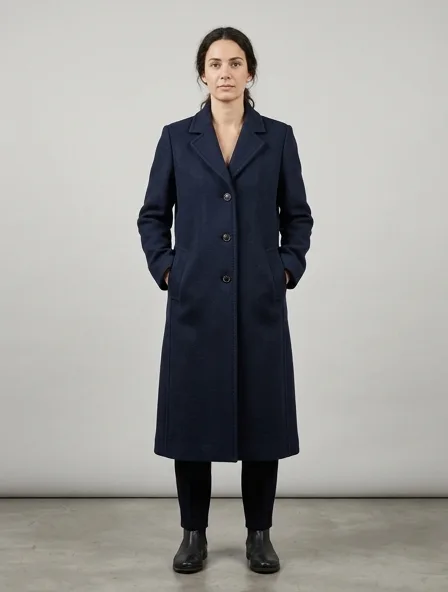
Six ideas for your fabric. Your free renders go first (two across all our tools), then sign in free to render the rest.
Your photo is stored for 30 days, then deleted. It is used to make your image, and by the studio if you continue there. If you order a pattern from it, a copy is kept with your order.
What a render picks up in wool
Wool comes in two families, and a photo tells them apart. Worsted cloth is spun from long, combed fibers into a smooth, hard yarn: the surface is clean, the twill or the pinstripe is crisp, and a suit in it looks sharp at the edges. Woolen cloth is spun from shorter fibers and often brushed: flannel, tweed and melton show a soft, slightly hazy face that blurs the weave.
Pattern carries clearly. Herringbone, houndstooth, glen check and chalk stripe all come back at the scale of your photo, which makes the render a fast way to judge whether a check is too loud for a coat or too quiet for a jacket.
The cloth sets the silhouette. A dense melton coat stands off the body in clean planes with sharp cut edges; a wool crepe dress falls softly; a fine suiting sits close. The render takes those cues from what the photo shows, the surface and the fold, not from a weight it cannot measure, so name the cloth when it matters.
Where the render stops
- Tailoring. Canvas, interfacing, shoulder pads and pressing give a jacket its shape. The render invents a well-built jacket; yours will be as good as its construction.
- Check matching: on a real coat the checks have to meet across seams, pockets and the collar, which costs cloth and cutting time. A render matches them for free.
- Hand and warmth: whether the cloth feels soft or scratchy against the neck, and how warm it wears, never shows in an image.
- Shine and pilling: worsteds polish where they rub and woolens pill, both after wear, both invisible in a render.
The wool cloths a small label buys most
Wool is sold by cloth, not by fiber alone, and each cloth points to a different garment. The Super number on fine suitings (Super 100s, 120s and so on) refers to how fine the fiber is: higher is finer and softer, and also more delicate.
| Cloth | Typical weight | What it is for | In a render |
|---|---|---|---|
| Worsted suiting | About 230 to 320 GSM | Suits, tailored trousers | Crisp edges, fine stripes read well |
| Tropical wool | About 220 to 300 GSM | Summer trousers and suits | Reads like suiting; its openness does not show |
| Wool crepe | About 180 to 260 GSM | Dresses, soft tailoring | Soft fall reads; the grain of the crepe needs a close photo |
| Flannel | About 280 to 400 GSM | Trousers, jackets, winter suits | Hazy surface reads; weave blurs |
| Melton | About 400 to 750 GSM | Coats, outerwear | Clean planes and cut edges read well |
| Wool knit | About 250 to 500 GSM | Sweaters, cardigans | Stitch reads in close views; stretch does not |
How to photograph wool for the tool
Shoot close enough for the yarn to show, so the render knows worsted from woolen, then step back once for a check or a stripe so at least two full repeats are in the frame. Daylight from the side brings out a brushed surface; a fold at one corner shows how thick the cloth is.
Questions
Worsted or woolen for a coat?
Most coats are woolen cloths, melton, flannel or a double-faced wool, because they are dense, warm and can be cut with clean edges. Worsted is the usual choice for suits and trousers, where a smooth, sharp surface matters more than warmth.
Can AI show a herringbone or a check at the right scale?
Yes, at the scale your photo shows, so put a ruler or a coin beside the cloth if the scale matters. A render does not match the checks across seams the way a cutter must.
Can the render show how a wool coat will drape?
It shows the drape you would expect from the cloth in the photo. How the finished coat hangs also depends on interfacing and construction, which only a sample settles.
What does it cost?
Reading your wool and writing six garment ideas is free. Two free renders, shared across all our tools. No account. Then 5 credits ($0.50) a render; a free account opens with a one-time welcome of 50 credits, then gets 15 credits a month. A set of six costs 30 credits.