How can I see how a fabric will drape before cutting a sample?
Drape a length of the real fabric on a dress form, which is the only test that cannot be wrong, or simulate it in 3D software fed with the fabric’s measured properties. An image made from a photo of the fabric shows the look and the silhouette, not the physics, so use it to choose, then confirm on the cloth.
Three ways to see drape, from certain to quick
They answer different questions, and the quickest one is the least certain.
| Way | What it tells you | What it cannot |
|---|---|---|
| The real cloth on a form | Exactly how this fabric falls, folds and moves, in your hands | Nothing about a silhouette you have not cut yet, unless you pin one |
| 3D simulation from measured properties | How a pattern you drafted hangs in a fabric whose weight, stretch and bending were measured | Anything, if the fabric was not measured: preset values are a guess |
| An image from a photo of the fabric | The look: color, print scale, and the silhouette in that fabric | Weight, stretch, recovery and hand: a photo carries none of them |
Test the cloth itself
Before any sample, a length of the fabric answers most drape questions in ten minutes:
- Ask the mill or the shop for a header or a length, not only a small swatch: drape needs weight to show, so the bigger the piece, the truer the test.
- Hang it from a corner and from the middle of one edge. A fluid fabric falls in many narrow folds, a stiff one in a few wide ones.
- Pin it on a dress form in the rough shape of the garment: gathered at a waist, bias-draped across a bust, straight down from a shoulder.
- Stretch it in both directions and across the bias, and let go: see how far it gives and whether it comes back.
- Photograph each test in daylight. The photos become the reference you compare samples, and any image, against.
Simulate it in 3D
3D garment software drapes a pattern you have drafted over an avatar, and computes the folds from the fabric’s physical properties: its weight, thickness, bending, stretch and shear. The simulation is only as true as those numbers. A fabric picked from a preset library is an estimate; a fabric measured on your actual cloth is a close guide.
The software makers sell the measuring side too. Browzwear’s Fabric Analyzer measures mass, thickness, bend, stretch, linearity and shear and creates a digital fabric for its VStitcher software; CLO’s CLOFAB tool works with its zFab Kit. CLO lists an individual licence at $50 a month before tax. All read on their own pages on 19 October 2026.
This route needs a pattern to drape, and someone who drafts it, so it suits a garment you are developing rather than a fabric you are only considering.
Mills and labs can also measure drape itself, as a drape coefficient on a drape tester; ISO 9073-9 is one published method. Ask your mill whether it has the figure for the cloth you are considering.
Preview the look as an image
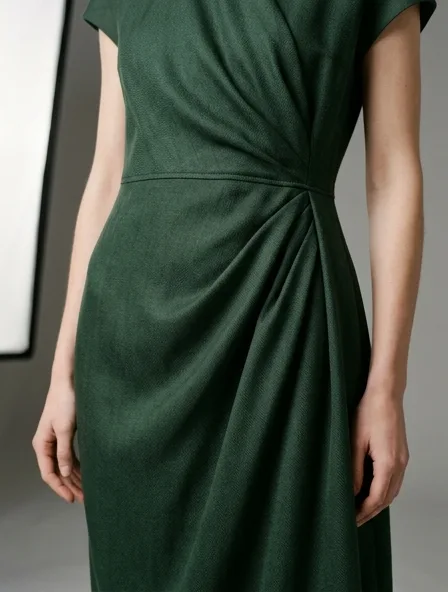
An image is the fastest way to see a silhouette in a fabric: drop a photo of the cloth and see garments rendered in it, with the print at its scale and the color as photographed. The render below is our own, generated from a description of a green twill dress, not from a photo: it shows the kind of picture you get, a convincing fall of cloth that no measurement produced.
That is its honest limit. The image knows how the fabric looks, not how heavy it is, how far it stretches or how stiff it is, so the drape you see is drawn, not computed. Use images to choose which fabric and which shape deserve a sample, then let the cloth decide.
Denim and activewear, where stretch decides
For jeans and for activewear the question is less how the fabric falls than how it stretches and recovers on a body. Ask the mill for the fabric’s weight and its stretch and recovery figures, test a length by hand as above, and treat any image, ours included, as a view of the wash, the color and the silhouette only.
What the image route costs here
The fabric read and six written garment ideas are free, with no account. Your first 2 renders are free, shared across all our tools; after that a render is 5 credits ($0.50), and all six pieces of a collection from one fabric are 30 credits. A free account opens with a one-time welcome of 50 credits, then gets 15 credits a month.
See garments in your fabric before you sample
Drop one photo of the cloth, flat and in daylight. You get six garment ideas with the motif placed, and the first pieces rendered in your fabric.
Questions
Can AI simulate fabric drape?
An image model can show a convincing drape, but it draws it from how the fabric looks, not from its weight, stretch or stiffness. Physics-based drape comes from 3D software fed with measured fabric properties, and the final word from the cloth itself.
What makes a fabric drape well?
Mostly its weight, how easily it bends and how it is constructed: a heavy, soft, fluid fabric such as a viscose crepe falls in many narrow folds; a light, stiff one such as an organza stands away from the body.
How big a piece of fabric do I need to test drape?
As big as you can get: a header or a length rather than a small swatch, because drape shows with weight. Hang it and pin it on a form in the rough shape of the garment.
Is 3D drape simulation accurate?
As accurate as the fabric data it is given. With properties measured on your actual fabric it is a close guide; with a preset from a library it is an estimate. Confirm on a sample either way.
Can I see my fabric on garments for free?
The fabric read and six written garment ideas are free with no account, and your first 2 renders, shared across all our tools, show pieces in your fabric. Then 5 credits ($0.50) a render.