Free tech pack template, Excel and PDF
Ten sheets a factory can work from: cover, flat sketches, bill of materials, measurements with grading and tolerances in cm and in inches, construction and stitch types, colourways, labels and trims, packaging, revision log. Download the blank to fill, and the worked example to see every field in use. No account, no email, nothing to unlock.
Download
Direct downloads. No sign-up, no email, no watermark. The Excel file is fully editable; the PDF is the same pack laid out for printing and for sending.
Blank template
Worked example
Both files hold the same ten sheets in the order a factory reads them. The example fills every sheet for one garment, a classic cotton poplin shirt, so each field shows the kind of answer it expects. Measurements come in cm and in inches; keep one unit on the version you send.
The ten sheets
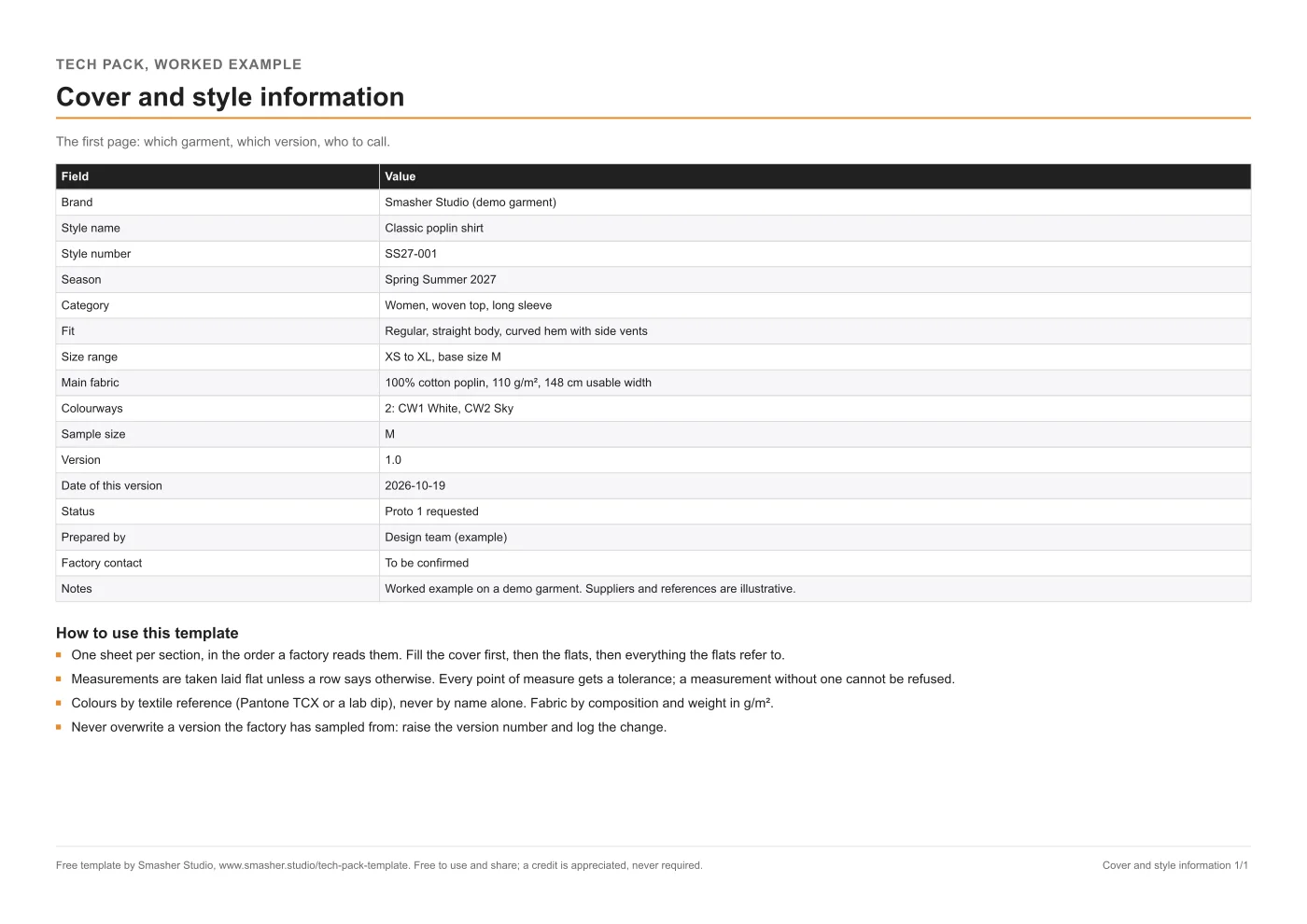
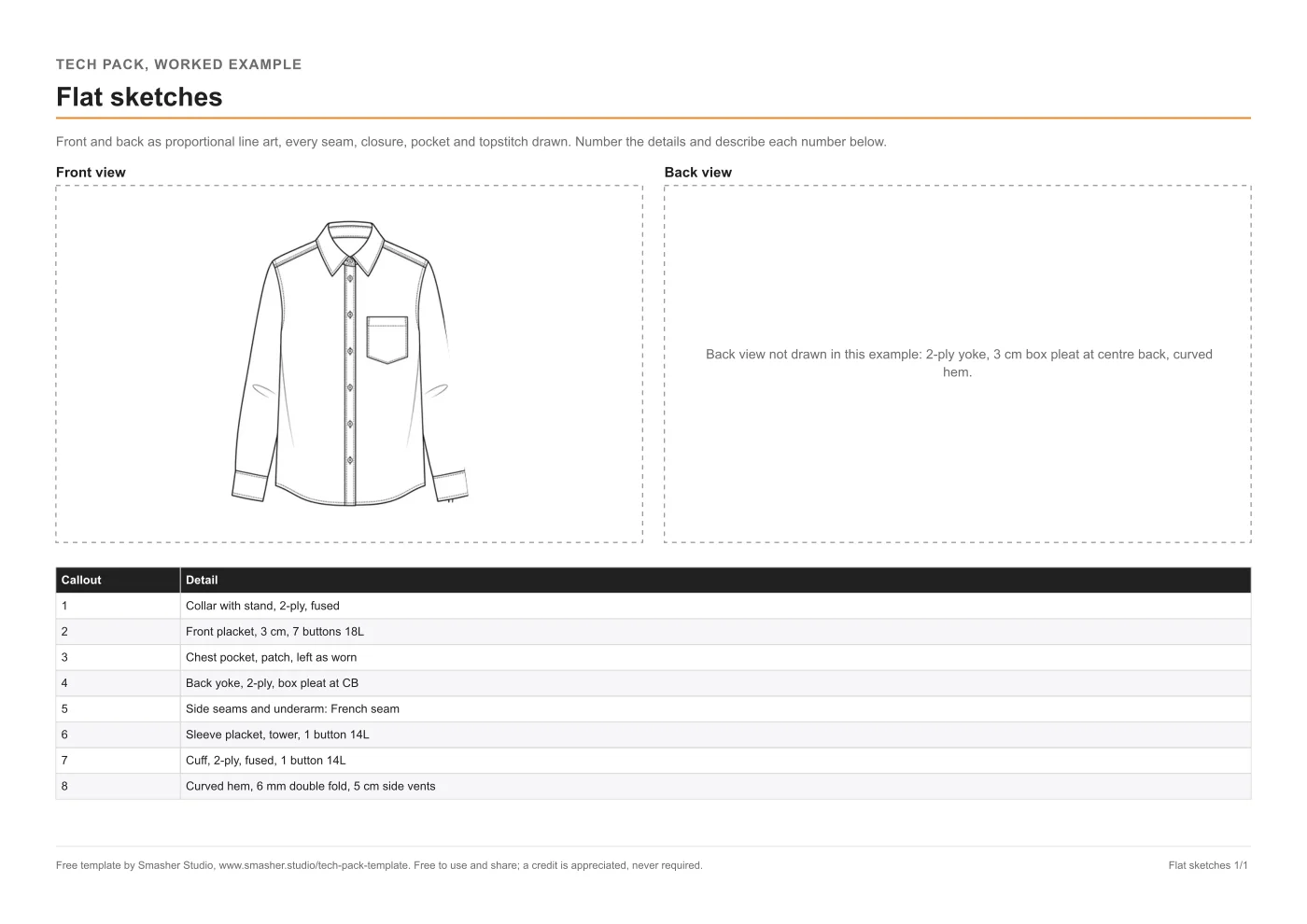
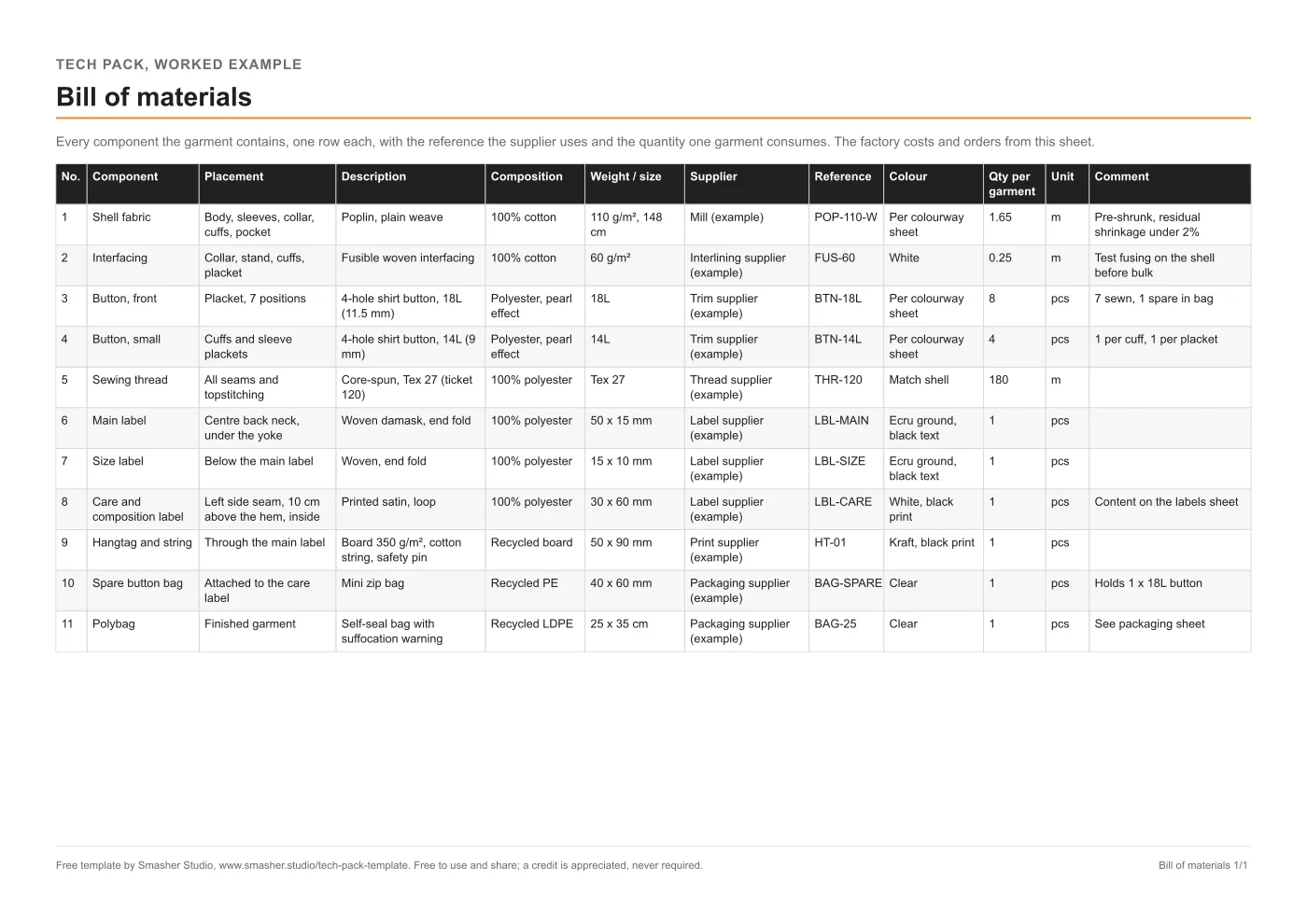
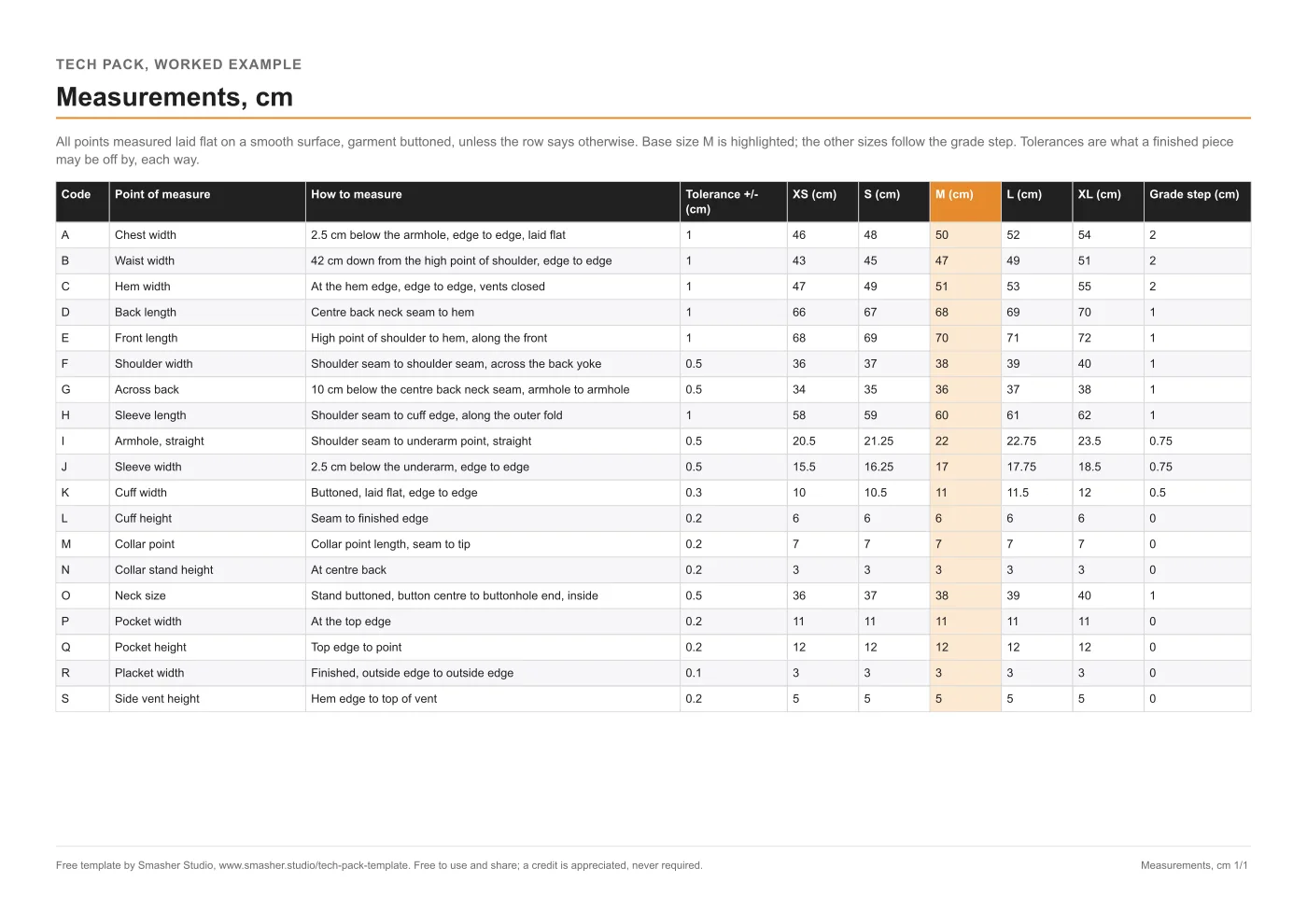
Every page of the worked example, as it prints. Open a preview to read it at full size.
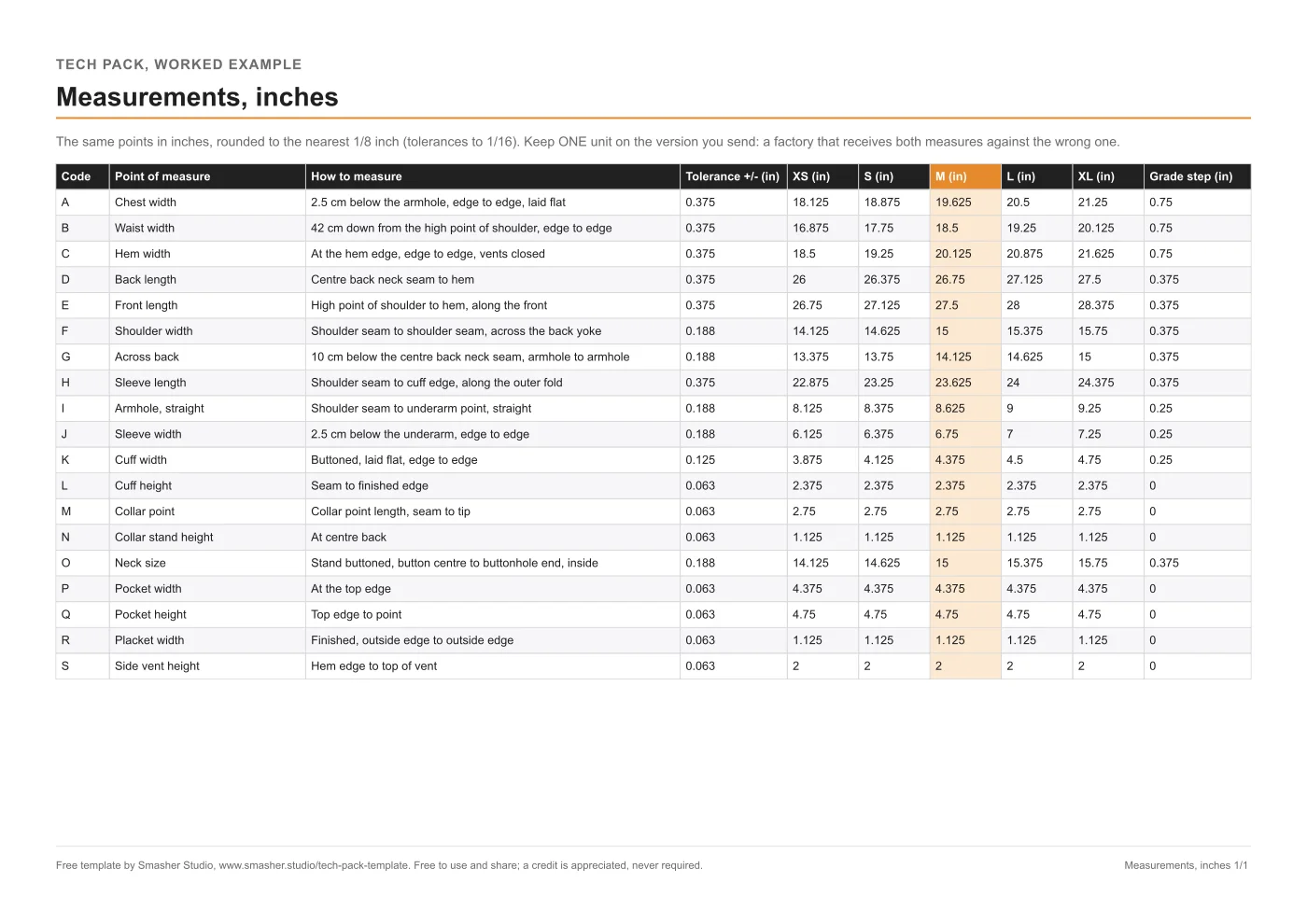
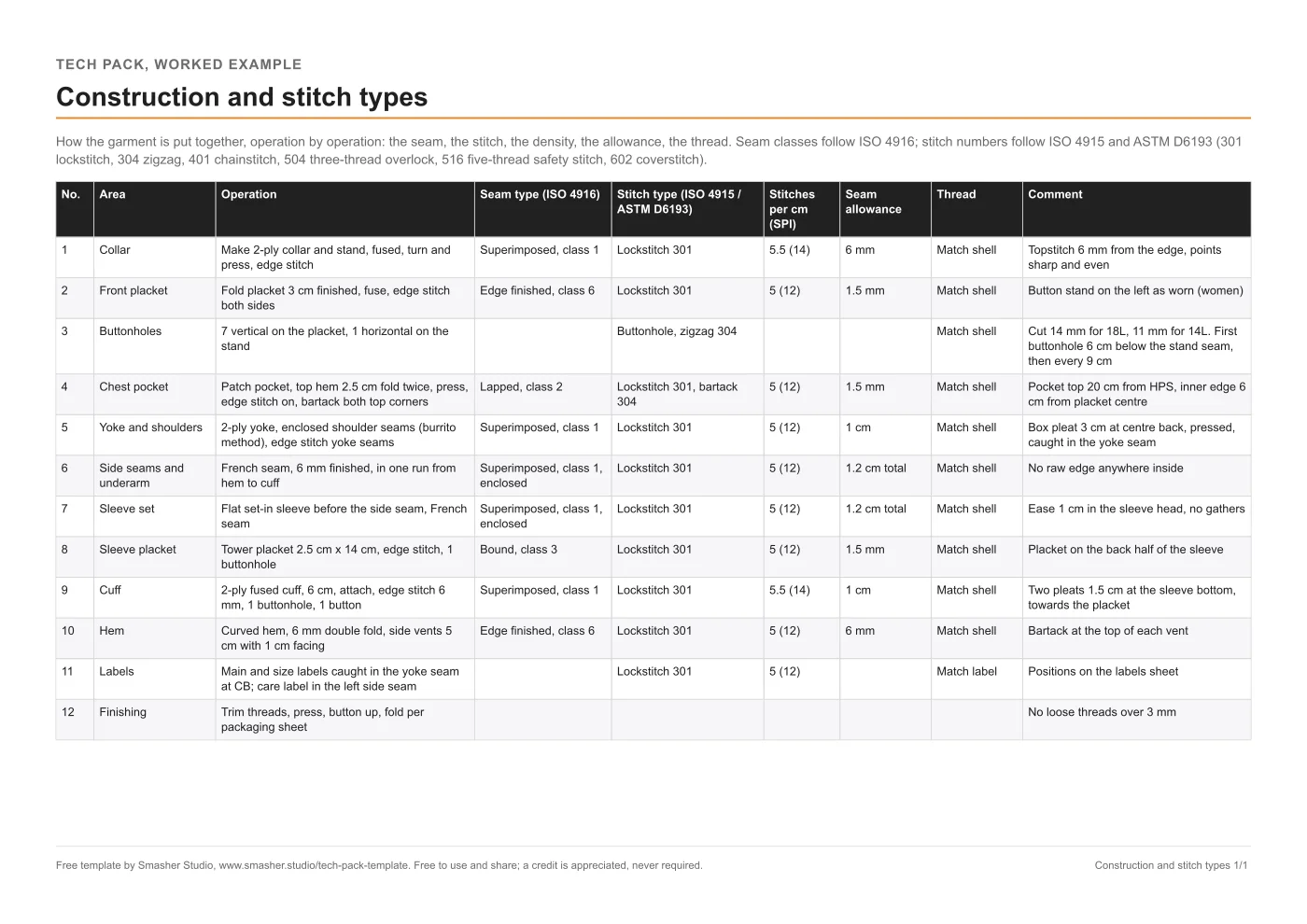
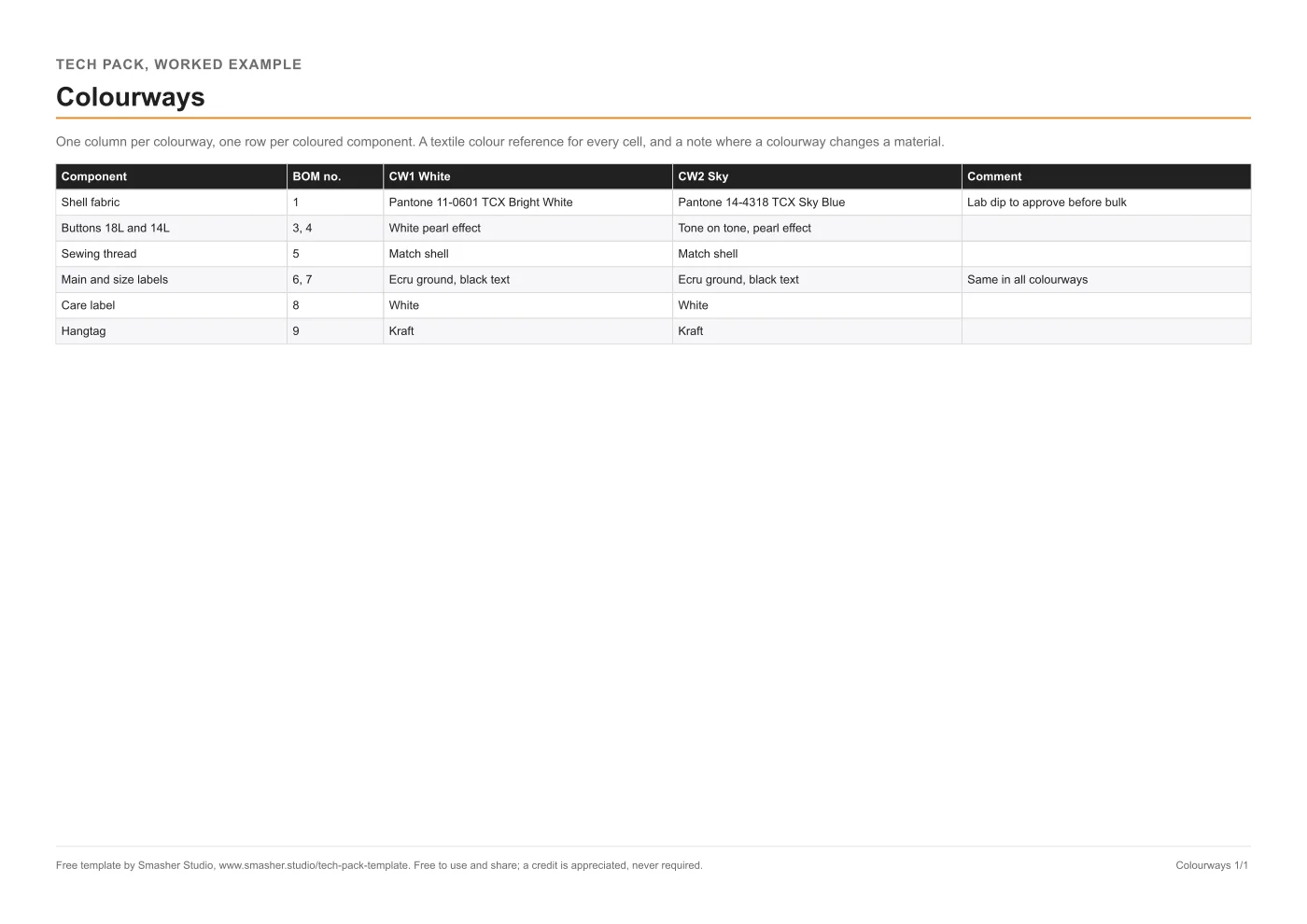
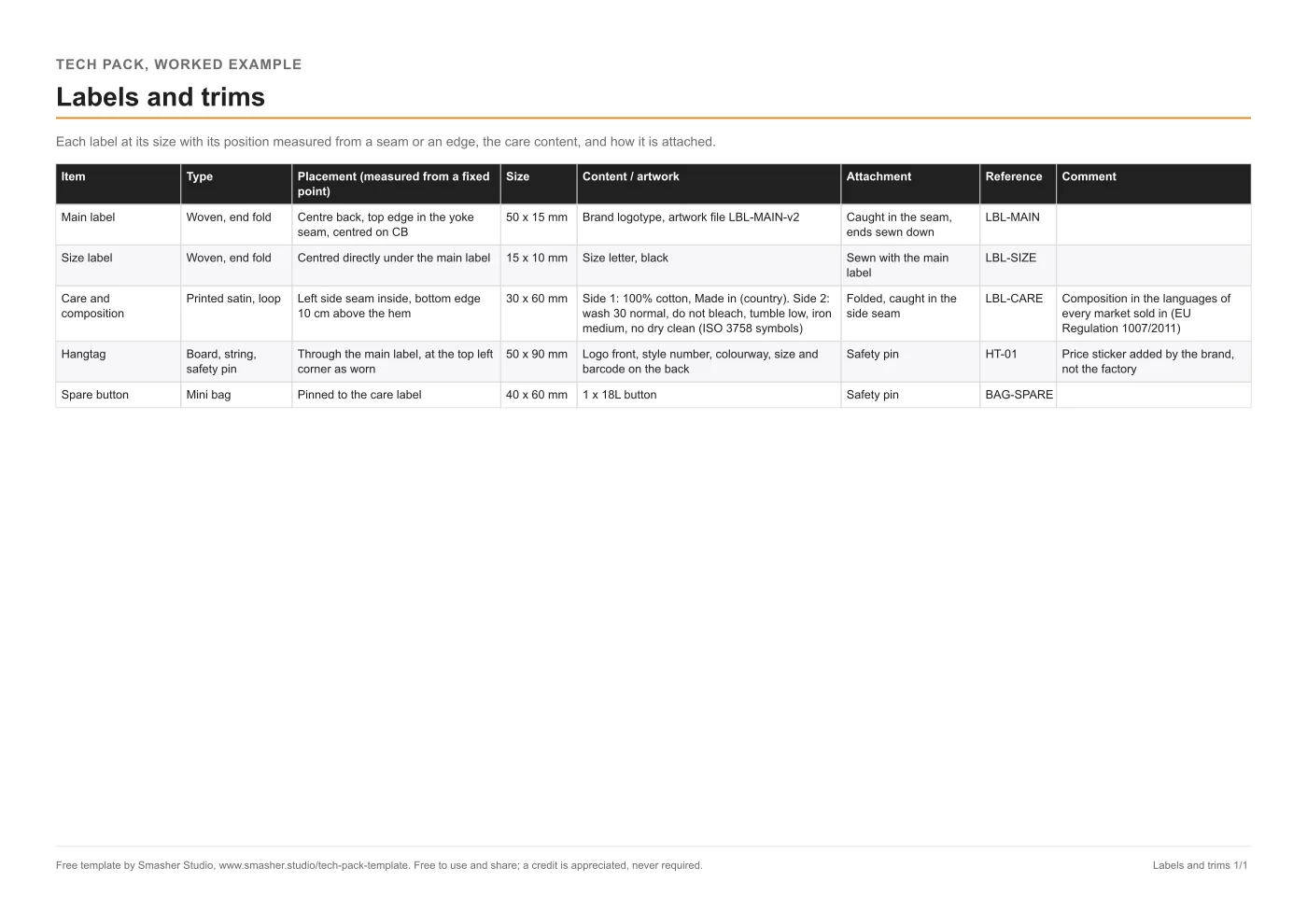
What a tech pack is
A tech pack is the document a factory builds a garment from. It answers the three questions a factory cannot guess: what to cut it from, how big each size is, and how to put it together. The merchandiser costs the garment from it, the pattern maker drafts from it, the sewing line assembles from it, and quality control measures the finished pieces against it.
Without one, the factory either asks questions for weeks or decides for you: a lighter fabric because no weight was given, an overlock where you wanted a French seam, a label in the wrong place. The tech pack is the written standard you can hold a sample to. This template gives you that standard as ten sheets, each one a page the factory expects to find.
How to fill each sheet
One sheet per section, in the order a factory reads them. Fill the cover first, then the flats, then everything the flats refer to.
| Sheet | What goes in it | The rule |
|---|---|---|
| 1. Cover and style information | Style name and number, season, category, fit, size range and base size, main fabric, colourway count, version and date, status, who to contact. | The version number on the cover is the one the factory samples from. Raise it on every change. |
| 2. Flat sketches | Front and back as proportional line art, every seam, closure, pocket and topstitch drawn. Numbered callouts with a legend below. | A flat is an engineering drawing, never a fashion illustration. A pattern maker cannot measure a figure. |
| 3. Bill of materials | Every component, one row each: shell, interfacing, thread, buttons or zip, labels, hangtag, bag. Composition, weight or size, supplier, reference, colour, quantity per garment, unit. | A component that is not on the list is never costed and never ordered. |
| 4. Measurements, cm | Points of measure with a code matching the flat, a plain description of where the tape goes, a tolerance, the base size, the graded sizes and the grade step. | Say how each point is measured, laid flat or on a form, half or full. Every point gets a tolerance. |
| 5. Measurements, inches | The same points converted, rounded to the nearest 1/8 inch, tolerances to 1/16. | Send one unit only. A factory that receives both measures against the wrong one. |
| 6. Construction and stitch types | Operation by operation: the seam type, the stitch type, stitches per cm or per inch, the seam allowance, the thread, and where to reinforce. | Quote the standard with the number: ISO 4916 for seams, ISO 4915 or ASTM D6193 for stitches. "301 lockstitch, 5 per cm" is unambiguous; "normal stitching" is not. |
| 7. Colourways | One column per colourway, one row per coloured component: shell, thread, buttons, labels, hangtag. | A textile colour reference in every cell (Pantone TCX or an approved lab dip), never a colour name alone. |
| 8. Labels and trims | Each label at its size, with its position measured from a seam or an edge, its content, its material and how it is attached. | Care symbols follow ISO 3758; fibre composition goes on the label in the language of every market you sell in. |
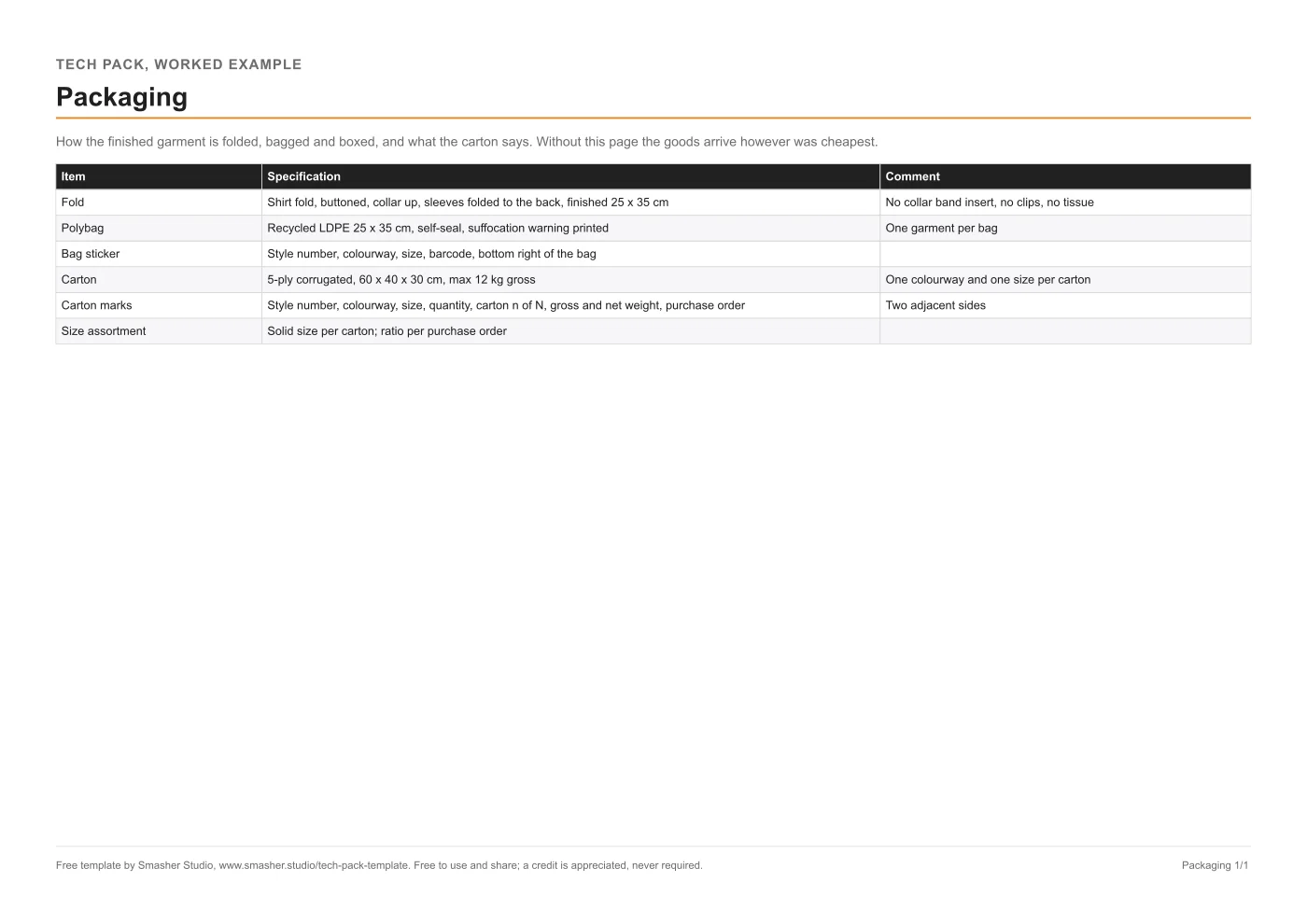
| 9. Packaging | The fold, the bag and its sticker, the carton and what it is marked with, the size assortment per carton. | Without this page the goods arrive folded and boxed however was cheapest. |
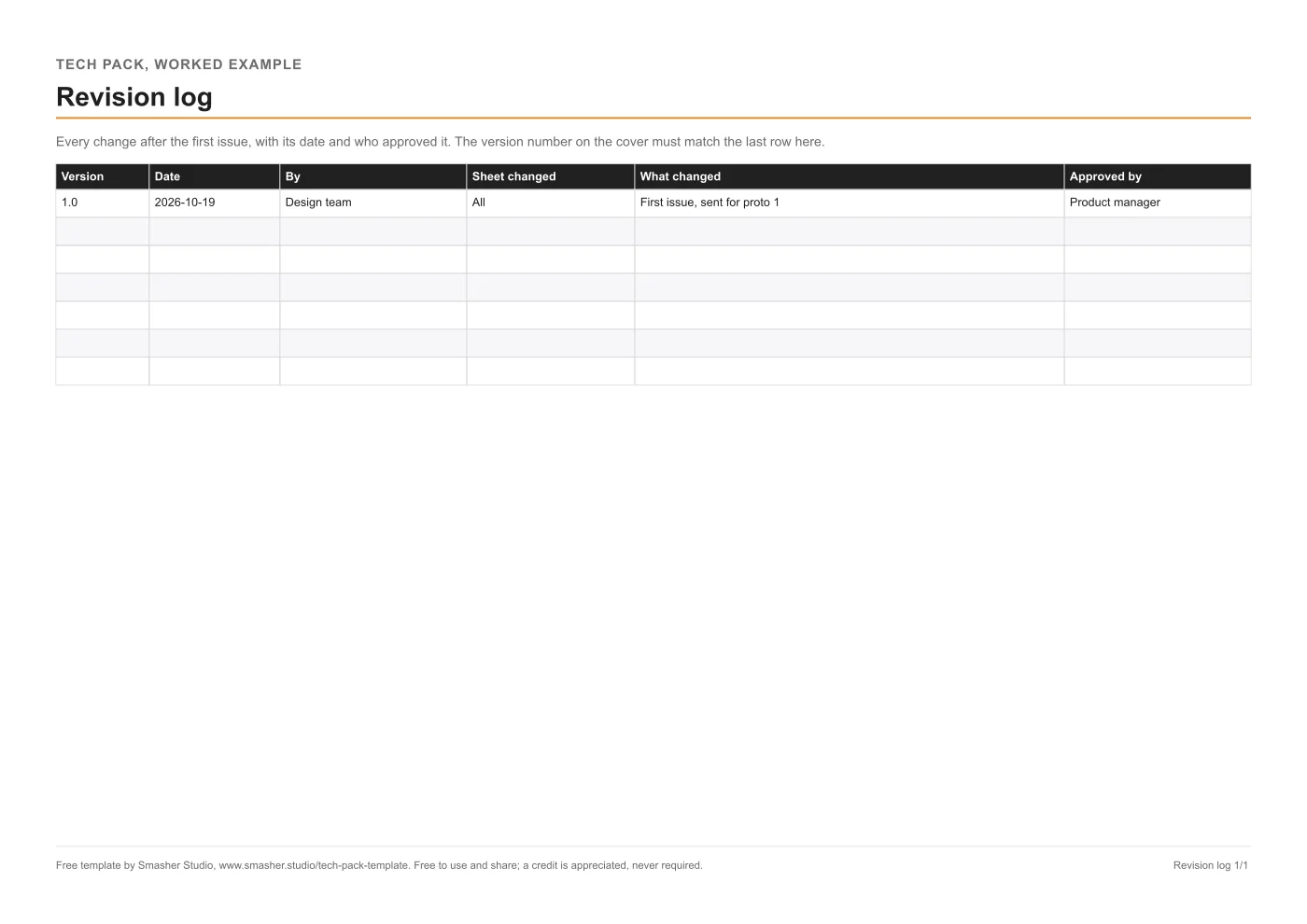
| 10. Revision log | Version, date, author, sheet changed, what changed, who approved it. | The last row here equals the version on the cover. Never overwrite a version the factory has sampled from. |
Measurements and tolerances, in practice
The measurement sheet is where most first tech packs fall short, and where a sample is accepted or refused. A tolerance is the amount a finished piece may be off by, each way; a measurement without one cannot be refused, because nothing says when it is wrong. The numbers below are starting values to confirm with your factory and your own fit, not a standard.
- Chest, waist, hip and shoulder: about 0.5 to 1 cm (1/4 inch) laid flat. These decide the fit.
- Body and sleeve lengths: up to 1 cm (3/8 inch), sometimes 1.25 cm (1/2 inch) on a long piece.
- Collars, cuffs, plackets, pocket sizes: 0.2 to 0.3 cm (1/8 inch). Small parts are cut from fused pieces and should not move.
- Garments that are washed or garment-dyed after sewing: add roughly half again to every tolerance, and say that the figures are after wash.
- Say whether a width is a flat (half) measure or a full circumference. A chest of 50 cm laid flat is a 100 cm chest; a factory that reads it the other way cuts a garment for a child.
- Give the grade step per point, not just the base size. A chest that grows 2 cm per size and a cuff that does not grow at all are both normal; the sheet has to say which is which.
Common mistakes
- A fashion illustration in place of flats, or flats without the back view.
- Measurements with no tolerances, so an off-spec sample cannot be refused.
- Colours by name ("dusty rose") instead of a textile colour reference.
- Fabric named without its weight and composition, so the mill quotes something lighter.
- No seam allowance or stitch density stated, so the factory applies its own default.
- Labels positioned "at the neck" instead of measured from a seam.
- No version table, so the factory samples from an older pack.
- No packaging page, so the goods arrive bagged however was cheapest.
- Both cm and inches on the same version sent to the factory.
Excel or PDF, and how to adapt the template
Work in the Excel file: every sheet is a plain table with frozen headers, no macros and no protection, so it opens in Excel, Numbers, LibreOffice and Google Sheets. Delete the points of measure you do not use, add rows where you need them, and keep the column order so a factory that has seen the pack before finds its way.
Send the PDF. Export your own once the pack is filled (every sheet is set to print on one landscape page width) and keep the Excel file as the source for the next version. The example PDF shows the finished look.
For a knit, a trouser or a dress, the sheets stay the same; only the rows change. The blank measurement sheet lists the common points for tops and for bottoms, to delete from. The construction sheet names the common stitch classes to pick from.
Skip the template: start from a photo
If the garment exists, as a sample, a vintage piece you are adapting or a render, you do not have to start the flats from a blank page. Drop a photo in the pattern tool: it comes back as a black-line flat and a read of the construction, with the production DXF pattern quoted. A professional pattern maker cuts the pattern, and can write the factory tech pack as an add-on at $10, so the specification and the cutting files agree.
Two free renders, shared across all our tools. No account.
Get a tech pack from a photoFree to use, credit appreciated
Use the template for your own garments, your students or your clients, edit it, share it. A link back helps other people find it and is appreciated, never required. If you teach or write about tech packs and want a snippet to paste:
Attribution snippet (optional)
<a href="https://www.smasher.studio/tech-pack-template">Free tech pack template by Smasher Studio</a>Questions
Is the tech pack template really free?
Yes. The files are direct downloads with no account, no email and no watermark, and you may use and share them for personal, commercial and teaching work. A credit is appreciated, never required.
What is included in the template?
Ten sheets: cover and style information, flat sketches front and back with callouts, bill of materials, measurements with grading and tolerances in cm and in inches, construction and stitch types, colourways, labels and trims, packaging, and a revision log. Each comes blank and filled for one garment.
Does it open in Google Sheets or Numbers?
Yes. The Excel file uses plain tables with no macros and no protection, so it opens in Excel, Google Sheets, Numbers and LibreOffice. The flat sketch sheet holds a placeholder box for your own drawing; the example embeds the drawing as an image.
Should I send the factory cm or inches?
Whichever your factory works in, and only that one. The template carries both sheets so you can convert once and check; delete the other before you send, so nobody measures against the wrong unit.
What is the example garment?
A classic women’s cotton poplin shirt, one of our own demo garments. The suppliers and references on it are placeholders and the cover says so; the measurements are plausible figures for a size M base, not a sizing standard.
Do I still need a pattern?
Yes, to produce. A tech pack describes the garment; a pattern is the set of pieces the factory cuts. Some factories draft the pattern from your pack for a fee; otherwise you send both. From a photo of the garment, the pattern tool quotes the production DXF pattern, and the pattern maker can write the factory tech pack with it.
Can my school or blog link to this page?
Please do. The attribution snippet above is there for that, and it is optional. The files stay at the same addresses, so a link to this page or straight to a file keeps working.