Wool fabric guide
Wool Blouse Design with AI
A wool blouse is a specialist order: ask for wool challis at 110 to 160 g/m², and expect fewer mills to take it on.
Of the 12 cloths this guide lists for this cut, it sits between polyester crepe and shirting linen in weight.
Next to shirting linen, it is lighter, more fluid, warmer to wear and more demanding to care for.
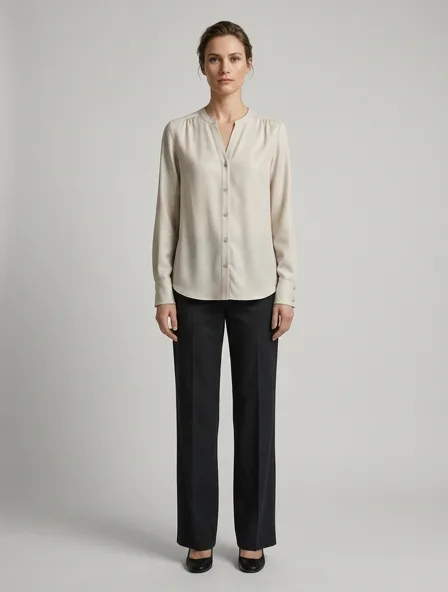
Wool Blouse at a glance
- Cloth to ask your mill for
- Wool challis
- Typical weight
- 110 to 160 g/m²
- Drape
- Soft
- Stretch
- Slight
- Breathability
- High
- Warmth
- Warm
- Care
- Dry clean
- How common
- Niche, usually a specialist order
- Typical cloth price
- $15-80/yard
Typical trade ranges, not one mill's figures: confirm them with your mill.
The blouse, in numbers
- Typical length
- 58 to 68 cm, from the high point of the shoulder
- Defining details
- Bow neck, gathered or puffed sleeves, buttons at the back or front, soft pleats
- Cloth needed
- about 1.4 to 2.0 m of 150 cm cloth, roughly $23 to $170 of cloth at typical prices
Typical figures for an adult size M. The pattern tier is set from the real piece count when you order.
How wool behaves on a blouse
On a blouse it skims the body without clinging, and gathers at a yoke or a cuff sit softly instead of standing up.
At this length a soft cloth moves gently at the hem and falls in loose folds.
It wears warm, which places it in autumn and winter collections.
The finished piece is usually labelled dry clean only.
It recovers from creases overnight and resists dirt, but it felts if washed hot and moths eat it in storage.
About wool
Wool is the fleece of the sheep: springy, warm even when damp and naturally resistant to odour. Fine merino feels soft against skin, while coarser wools give tweed and melton their body.
Fine merino comes mostly from Australia and New Zealand; Biella in Italy and Yorkshire in England are known for fine worsted cloths.
Wool dresses, skirts and tailoring are usually lined in viscose or cupro so they slide and do not itch.
Cutting, sewing and color
An 80/12 needle; wool shapes with steam, so ease a sleeve head or a curve with the iron rather than with extra seams.
It takes acid dyes evenly, and heathers and marls come from blending dyed fibres before spinning.
Its surface is matte, so it photographs evenly under flat light.
A description to start from
A blouse in wool challis, 110 to 160 g/m², with a soft drape and a matte surface, for autumn and winter.
If wool is not quite right
- Lighter: Cotton, in cotton poplin
- Heavier: Linen, in shirting linen
Also: how the studio works, prices and questions and answers.
Start free