Organza fabric guide
Organza Tunic Design with AI
A organza tunic is a specialist order: ask for organza at 25 to 60 g/m², and expect fewer mills to take it on.
It is the lightest of the 12 cloths this guide lists for this cut; chiffon comes next.
Next to chiffon, it is lighter and firmer.
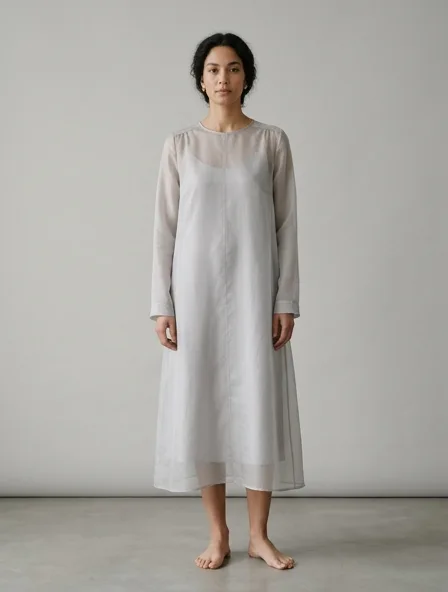
Organza Tunic at a glance
- Cloth to ask your mill for
- Organza
- Typical weight
- 25 to 60 g/m²
- Drape
- Crisp, stands away from the body
- Stretch
- None
- Breathability
- High
- Warmth
- Cool to wear
- Care
- Dry clean
- How common
- Niche, usually a specialist order
- Typical cloth price
- $10-30/yard
Typical trade ranges, not one mill's figures: confirm them with your mill.
The tunic, in numbers
- Typical length
- 75 to 90 cm, from the high point of the shoulder
- Defining details
- Side slits, split neck, long or three-quarter sleeves, hip to thigh length
- Cloth needed
- about 1.6 to 2.2 m of 150 cm cloth, roughly $17 to $72 of cloth at typical prices
Typical figures for an adult size M. The pattern tier is set from the real piece count when you order.
How organza behaves on a tunic
On a tunic it stands slightly away from the body, so collars and cuffs hold their shape and a boxy cut stays boxy.
Cut long, a crisp cloth builds volume, the more so with every gore or pleat.
It wears cool, which makes it a spring and summer fabric.
The finished piece is usually labelled dry clean only.
It creases sharply and the creases stay, so it is pressed and stored with care.
About organza
Organza is a sheer, crisp plain weave made from tightly twisted filament yarns, in silk or polyester. It holds volume where chiffon would fall.
Silk organza for couture is woven in Italy, France and China; polyester organza is common and cheaper.
It is used as an overlay or an underlining more often than as a garment on its own.
Cutting, sewing and color
French seams, because every seam shows through, and a 60/8 or 70/10 needle; it holds a pressed edge crisply.
Shot organza, woven from two colors, changes shade with the light and renders well in motion.
It has a soft sheen that shows the folds without glare.
A description to start from
A tunic in organza, 25 to 60 g/m², with a crisp drape and a soft sheen surface, for spring and summer.
If organza is not quite right
- Heavier: Chiffon, in chiffon
- Warmer: Leather, in lamb nappa leather
- Easier to care for: Cotton, in cotton poplin
- More drape: Silk, in silk crêpe de Chine
Also: how the studio works, prices and questions and answers.
Start free