Leather fabric guide
Leather Tunic Design with AI
A leather tunic is a specialist order: ask for lamb nappa leather at 0.5 to 0.7 mm thick, and expect fewer mills to take it on.
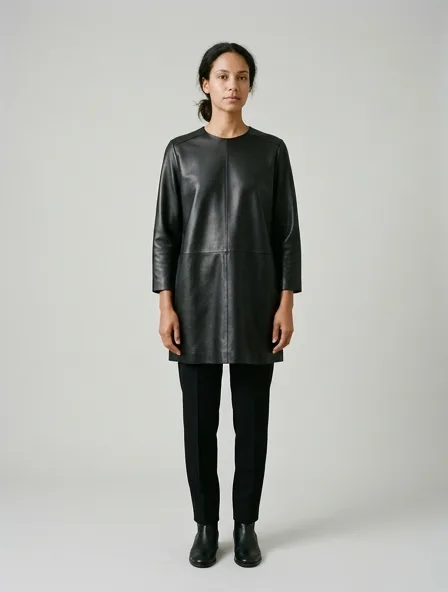
Leather Tunic at a glance
- Cloth to ask your mill for
- Lamb nappa leather
- Typical weight
- 0.5 to 0.7 mm thick
- Drape
- Structured, holds its own shape
- Stretch
- Slight
- Breathability
- Medium
- Warmth
- Warm
- Care
- Leather specialist clean only
- How common
- Niche, usually a specialist order
- Typical cloth price
- $20-100/sq ft
Typical trade ranges, not one mill's figures: confirm them with your mill.
The tunic, in numbers
- Typical length
- 75 to 90 cm, from the high point of the shoulder
- Defining details
- Side slits, split neck, long or three-quarter sleeves, hip to thigh length
- Cloth needed
- about 1.6 to 2.2 m of 150 cm cloth, or about 24 to 33 sq ft of hide, roughly $480 to $3300
Typical figures for an adult size M. The pattern tier is set from the real piece count when you order.
How leather behaves on a tunic
On a tunic it holds its own shape, which suits a cropped, boxy or sculpted top more than a fitted one.
Cut long, a structured cloth is heavy and stiff, so it suits a straight, coat-like line more than a flowing one.
It wears warm, which places it in autumn and winter collections.
Cleaning goes to a leather specialist, which buyers should know before they order.
It moulds to the body and develops a patina, scuffs show on aniline finishes, and every needle hole is permanent.
About leather
Leather is an animal hide made stable by tanning, sold by the square foot and specified by its thickness in millimetres. Lamb is soft and light, cowhide firmer and tougher.
Hides vary in size and in flaws, so the pattern is laid out on each hide by hand or by a nesting program; ask for the tannage, chrome or vegetable, in the quote.
Jackets and coats are lined in cupro, viscose or cotton so they slide on, and skirts and trousers often are too.
Cutting, sewing and color
A leather needle, a long stitch and clips instead of pins; every hole is permanent, so settle the fit before the hide is cut.
Color comes from the tannery: an aniline finish shows the hide, a pigmented finish covers it evenly.
It has a soft sheen that shows the folds without glare.
A description to start from
A tunic in lamb nappa leather, 0.5 to 0.7 mm thick, with a structured drape and a soft sheen surface, for autumn and winter.
If leather is not quite right
- Cooler: Cotton, in cotton poplin
- More drape: Silk, in silk crêpe de Chine
Also: how the studio works, prices and questions and answers.
Start free