Tweed fabric guide
Tweed Blouse Design with AI
A tweed blouse is a specialist order: ask for wool tweed at 300 to 400 g/m², and expect fewer mills to take it on.
It is the heaviest of the 12 cloths this guide lists for this cut, ahead of lightweight denim.
Next to lightweight denim, it is heavier, warmer to wear and more demanding to care for.
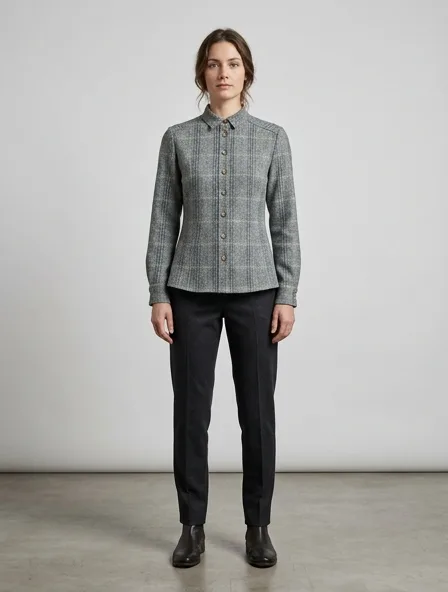
Tweed Blouse at a glance
- Cloth to ask your mill for
- Wool tweed
- Typical weight
- 300 to 400 g/m²
- Drape
- Structured, holds its own shape
- Stretch
- Slight
- Breathability
- Medium
- Warmth
- Warm
- Care
- Dry clean
- How common
- Niche, usually a specialist order
- Typical cloth price
- $20-60/yard
Typical trade ranges, not one mill's figures: confirm them with your mill.
The blouse, in numbers
- Typical length
- 58 to 68 cm, from the high point of the shoulder
- Defining details
- Bow neck, gathered or puffed sleeves, buttons at the back or front, soft pleats
- Cloth needed
- about 1.4 to 2.0 m of 150 cm cloth, roughly $31 to $130 of cloth at typical prices
Typical figures for an adult size M. The pattern tier is set from the real piece count when you order.
How tweed behaves on a blouse
On a blouse it holds its own shape, which suits a cropped, boxy or sculpted top more than a fitted one.
At this length a structured cloth holds the shape of the pattern from top to hem.
It wears warm, which places it in autumn and winter collections.
The finished piece is usually labelled dry clean only.
It is very hard-wearing and sheds light rain, but heavy tweed is bulky at the seams and stiff at first.
About tweed
Tweed is a rough, warm woollen cloth woven from yarns dyed before weaving, which gives it its flecks and its checks. It was made for the outdoors and remains one of the most durable cloths.
Harris Tweed is hand-woven in the Outer Hebrides of Scotland and carries its own certification mark; most other tweeds come from Scotland, England, Ireland and Italy.
Tweed jackets, coats and skirts are lined in viscose or cupro, for comfort and so the cloth does not catch.
Cutting, sewing and color
A 90/14 needle; match the check or the stripe at every seam, and tape the edges so they do not stretch.
Its color comes from yarns dyed before weaving, so the flecks are part of the cloth, not printed on it.
Its surface is matte, so it photographs evenly under flat light.
A description to start from
A blouse in wool tweed, 300 to 400 g/m², with a structured drape and a matte surface, for autumn and winter.
If tweed is not quite right
- Lighter: Denim, in lightweight denim
- Cooler: Cotton, in cotton poplin
- More drape: Silk, in silk crêpe de Chine
Also: how the studio works, prices and questions and answers.
Start free