Denim fabric guide
Denim Tunic Design with AI
Mills make denim tunics regularly, usually in lightweight denim at 140 to 240 g/m².
Of the 12 cloths this guide lists for this cut, it sits between silk and viscose velvet and wool tweed in weight.
Next to silk and viscose velvet, it is heavier, firmer, more matte and cooler to wear.
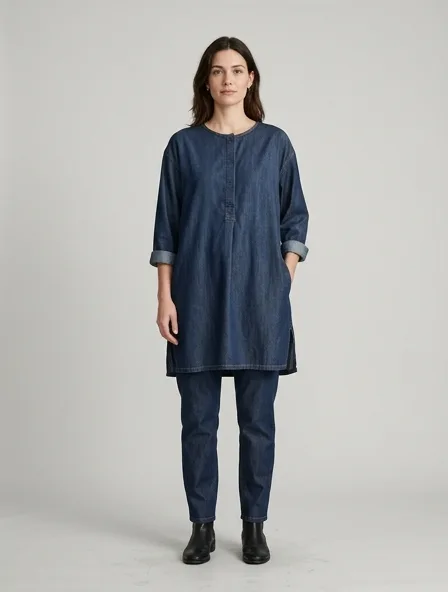
Denim Tunic at a glance
- Cloth to ask your mill for
- Lightweight denim
- Typical weight
- 140 to 240 g/m²
- Drape
- Structured, holds its own shape
- Stretch
- Slight
- Breathability
- Medium
- Warmth
- Neutral
- Care
- Machine wash cold, inside out
- How common
- Common
- Typical cloth price
- $8-30/yard
Typical trade ranges, not one mill's figures: confirm them with your mill.
The tunic, in numbers
- Typical length
- 75 to 90 cm, from the high point of the shoulder
- Defining details
- Side slits, split neck, long or three-quarter sleeves, hip to thigh length
- Cloth needed
- about 1.6 to 2.2 m of 150 cm cloth, roughly $14 to $72 of cloth at typical prices
Typical figures for an adult size M. The pattern tier is set from the real piece count when you order.
How denim behaves on a tunic
On a tunic it holds its own shape, which suits a cropped, boxy or sculpted top more than a fitted one.
Cut long, a structured cloth is heavy and stiff, so it suits a straight, coat-like line more than a flowing one.
It is neither warm nor cool, so it works across most of the year.
Wash it cold and inside out to keep the color.
It fades where the body creases, and rigid denim shrinks unless it is sanforised, so the mill's shrinkage figure belongs on the spec sheet.
About denim
Denim is a cotton twill woven with indigo-dyed warp yarns and an undyed weft, which is why it is blue on the face and pale on the back. Its weight, in ounces per square yard, decides how it wears.
Selvedge denim from narrow shuttle looms is a specialist product, made notably in Japan, Italy and the United States; most denim comes from wide looms in Turkey, Pakistan, India and China.
It is almost never lined; seams are flat-felled or bound so the inside looks finished.
Cutting, sewing and color
A 100/16 or 110/18 jeans needle and a heavier thread; flat-felled seams and bar tacks at the stress points.
Indigo is the classic dye, and washes from rinse to bleach change the shade after the garment is sewn.
Its surface is matte, so it photographs evenly under flat light.
A description to start from
A tunic in lightweight denim, 140 to 240 g/m², with a structured drape and a matte surface, for most of the year.
If denim is not quite right
- Lighter: Velvet, in silk and viscose velvet
- Heavier: Tweed, in wool tweed
- Warmer: Leather, in lamb nappa leather
- More drape: Silk, in silk crêpe de Chine
Also: how the studio works, prices and questions and answers.
Start free