Can AI design sandals for me?
Yes. A sandal is a sole and a set of straps, so describe those two: where the straps cross the foot and how they close, then the footbed and the sole height. The studio draws your sandal from that sentence, side-on, ready to recolor or to hand to a footwear maker.
Two free renders, shared across all our tools. No account.
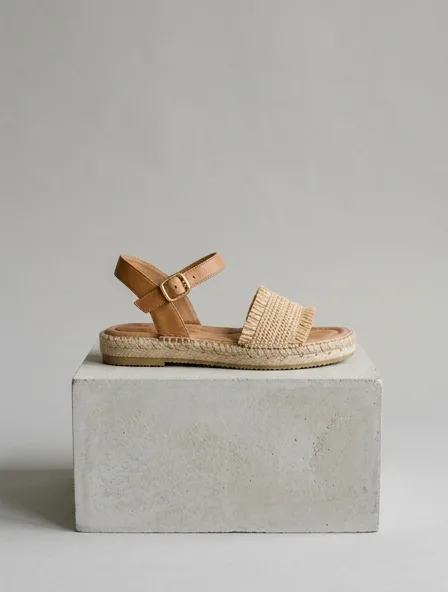
The strap layout is the design
Change the straps and you have a different sandal on the same sole. That is why sandal ranges are built as one footbed with three or four strap stories, and why your brief should spend most of its words there.
- Slide: one wide band or two crossed straps over the forefoot, no heel strap. The quickest to wear and to make.
- Two-strap or buckle sandal: a toe strap and an ankle strap with a buckle, often joined by a strap at the heel.
- Fisherman: a closed, woven or cut-out front with a heel strap, half shoe, half sandal.
- Gladiator: several horizontal straps up the foot, sometimes to the calf, closed by a zip or laces at the back.
- Thong (toe post): one strap between the first two toes, splitting over the foot. The post position decides comfort, so draw it clearly.
Footbed and sole: say what the foot stands on
Cork and leather footbeds read as natural and summery; molded rubber or foam as sport; a raffia-wrapped wedge as resort. The sole adds the second half of the message: a thin leather sole is dressy, a chunky tread is utility, a flatform is fashion.
Give one height in the brief, for example "3 cm cork footbed" or "5 cm flatform". A sandal described without a height comes back flat, and that is rarely what a fashion buyer wants to see.
Three sandal briefs to adapt
Each one names the strap layout, the closure, the footbed and the sole. Paste it in the studio, then change the leather and color to your season.
Crossed-strap slide
Brief to paste
A flat slide sandal with two wide crossed straps in tan vegetable-tanned leather, a contoured cork footbed, a thin rubber sole, side profile on white.
Woven fisherman
Brief to paste
A fisherman sandal in dark brown woven leather strips, closed toe, open sides, an adjustable buckled heel strap, leather-covered footbed, 2 cm stacked sole, side profile on white.
Ask for a three-quarter view too: the weave reads better from the front.
Flatform gladiator
Brief to paste
A gladiator sandal in black smooth leather, five horizontal straps up to the ankle, a back zip, a 5 cm flatform in cream rubber with a ribbed edge, side profile on white.
After the drawing
With the design settled, render the same sandal in your color range, and make a product photo and a short turning clip to test it with customers before the sample exists. Then bring the images to a footwear factory: they build the last, cut the upper and source the sole. We do not draft footwear patterns; our pattern service is for clothing.
Questions
Can I design sandals with AI for free?
Yes, your first one: a guest’s first design image in the studio is free. Each image after that costs 5 credits ($0.50); signing up adds a one-time welcome of 50 credits, then 15 credits a month.
Can the AI copy a sandal I saw in a shop?
Describe what you liked about it (the strap layout, the footbed, the color) and design your own from there. A close copy of another brand’s sandal is not a design you can sell.
Will the factory understand an AI drawing?
Yes, as a design reference: it shows the strap layout, materials and proportions. Add the size range, the heel height and the materials in writing; the factory turns that into a last and a pattern.
Can I see my sandal design in motion?
Yes. In the studio, ask to animate the design you just made and it comes back as a short vertical clip.