Silk fabric guide
Silk Cardigan Design with AI
A silk cardigan is a specialist order: ask for silk knit at 180 to 280 g/m², and expect fewer mills to take it on.
It is the lightest of the 7 cloths this guide lists for this cut; linen knit comes next.
Next to linen knit, it is lighter, more fluid, shinier and warmer to wear.
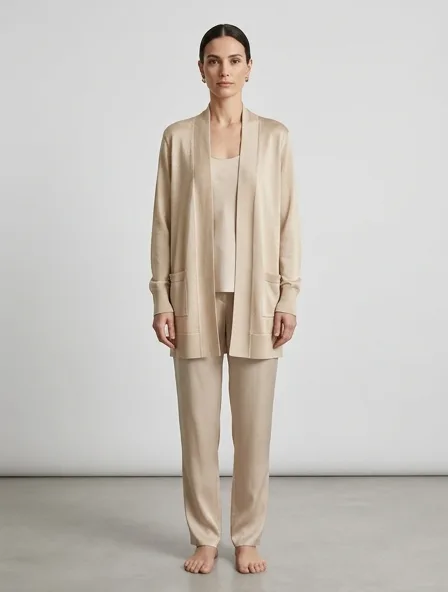
Silk Cardigan at a glance
- Cloth to ask your mill for
- Silk knit
- Typical weight
- 180 to 280 g/m²
- Drape
- Fluid, falls close to the body
- Stretch
- None
- Breathability
- High
- Warmth
- Neutral
- Care
- Dry clean
- How common
- Niche, usually a specialist order
- Typical cloth price
- $15-100/yard
Typical trade ranges, not one mill's figures: confirm them with your mill.
The cardigan, in numbers
- Typical length
- 60 to 70 cm, from the high point of the shoulder
- Defining details
- Button band, V or crew neck, patch pockets, rib trims
- Cloth needed
- about 1.4 to 1.9 m of 150 cm cloth, roughly $23 to $210 of cloth at typical prices
Typical figures for an adult size M. The pattern tier is set from the real piece count when you order.
How silk behaves on a cardigan
On a cardigan it slides over the shoulders and falls close to the body, so the cut needs very little ease and buttonholes want a light interfacing.
At this length a fluid cloth swings at the hem with each step and settles back close to the leg.
It is neither warm nor cool, so it works across most of the year.
The finished piece is usually labelled dry clean only.
Water can spot it, sunlight fades it and perspiration weakens it over time, so it suits occasion pieces more than daily wear.
About silk
Silk is a protein fibre unwound from the cocoon of the silkworm, the only natural filament fibre. It is light, strong for its weight and has a lustre no other fibre matches.
Most silk is reeled in China and India, and much of the finest is woven and printed around Como, in Italy; its weight is quoted in momme, about 4.3 g/m² each.
A silk piece is often left unlined, or lined in silk habotai when a pale color has to be opaque.
Cutting, sewing and color
Use a fine 60/8 or 70/10 needle, French seams and a press cloth; pins leave marks, so pin inside the seam allowance.
It takes acid dyes deeply, which is why a silk color looks richer than the same shade on cotton.
Its high sheen catches every fold, so light it from the side and keep the background quiet.
A description to start from
A cardigan in silk knit, 180 to 280 g/m², with a fluid drape and a high sheen surface, for most of the year.
If silk is not quite right
- Heavier: Linen, in linen knit
- Warmer: Wool, in wool knit
- Easier to care for: Cotton, in cotton knit
Also: how the studio works, prices and questions and answers.
Start free