Cashmere fabric guide
Cashmere Poncho Design with AI
For a cashmere poncho, most mills quote double-face cashmere at 500 to 800 g/m²: a classic pairing.
It is the heaviest of the 13 cloths this guide lists for this cut, ahead of wool melton.
Next to wool melton, it is heavier.
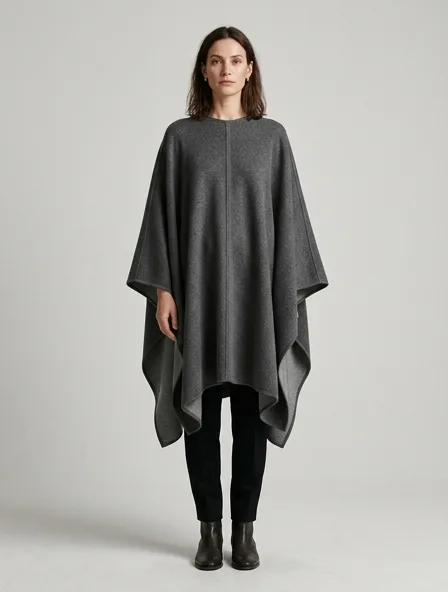
Cashmere Poncho at a glance
- Cloth to ask your mill for
- Double-face cashmere
- Typical weight
- 500 to 800 g/m²
- Drape
- Soft
- Stretch
- Slight
- Breathability
- High
- Warmth
- Warm
- Care
- Hand wash cold, dry flat
- How common
- A classic pairing
- Typical cloth price
- $50-200/yard
Typical trade ranges, not one mill's figures: confirm them with your mill.
The poncho, in numbers
- Typical length
- 70 to 90 cm, from the high point of the shoulder
- Defining details
- Head opening, fringed or bound edges, optional hood
- Cloth needed
- about 1.4 to 2.2 m of 150 cm cloth, roughly $77 to $480 of cloth at typical prices
Typical figures for an adult size M. The pattern tier is set from the real piece count when you order.
How cashmere behaves on a poncho
In a poncho it tailors well: the shoulder rolls naturally and the lapel presses into a soft line.
At this length a soft cloth moves gently at the hem and falls in loose folds.
It wears warm, which places it in autumn and winter collections.
It wants a cold hand wash and drying flat, so say so on the care label.
It pills where it rubs, especially at first, and it is washed gently and folded rather than hung.
About cashmere
Cashmere is the fine undercoat combed from cashmere goats. It is warmer than sheep's wool for its weight and very soft, and the finest fibres are long and white.
Most cashmere fibre comes from Mongolia and northern China, and much of it is spun and knitted in Scotland, Italy and China.
Knitted pieces are not lined; woven cashmere coats are lined in silk or cupro.
Cutting, sewing and color
Knitted to shape or cut from double-face cloth; handle it lightly, because pressing flattens the fibre.
It dyes well in soft, natural shades; very dark colors can make the hand feel harsher.
Its surface is matte, so it photographs evenly under flat light.
A description to start from
A poncho in double-face cashmere, 500 to 800 g/m², with a soft drape and a matte surface, for autumn and winter.
If cashmere is not quite right
- Lighter: Wool, in wool melton
- Cooler: Cotton, in cotton gabardine
- More structure: Tweed, in wool tweed
Also: how the studio works, prices and questions and answers.
Start free